Writing
UX 🤝 Product: Bridging Strategy & Delivery
My 2026 keynote at UX Camp in Calgary exploring the growing overlap between technology disciplines, my own identity crisis in design leadership, and how UX Designers got crowded out of strategic conversations.
The lines between UX and Product have never been thinner (or more contentious). What happens when both disciplines try to occupy the same space, and how do we manage the tension?
- How the UX–Product relationship evolved over time — and what that meant for strategy-oriented designers
- Why boundary spanners are more critical than ever
- How AI is changing the relationship between UX and Product
The official subtitle of the talk is "bridging strategy and delivery," but it might just as accurately be characterized as "my identity crisis in design leadership." The talk discusses the rise of product management as a strategic function, how that impacted a generation of UX Designers, and what the path forward looks like from here.


Act One: The Diagnosis
The talk began with a review of how the technology landscape has evolved over the last decade. From a rising tide that lifted the field, to hyper-growth as user-centred design approaches took over the business landscape, to the post-ZIRP era crash.
We also looked at the rise of "product-led growth" as coined by OpenView Venture Partners, and how product management ended up crowding UX designers out of strategic conversations. As product-led growth became the dominant business model for technology and software-as-a-service companies, the strategic centre shifted. When Product owns the "what" and the "why" and design owns "how," it divides the traditional design process in two — a divide that you can't hide from customers forever.
And yet, the actual gap between UX work and Product work is smaller than ever.
- Product connects customer value to business outcomes.
- Design achieves business outcomes through user understanding.
These are the exact same definitions with the order flipped. When we're both trying to operate in the same space, it shouldn't come as a surprise that product teams tend to have a tendency to step on each other's toes.
Act Two: The Path Forward
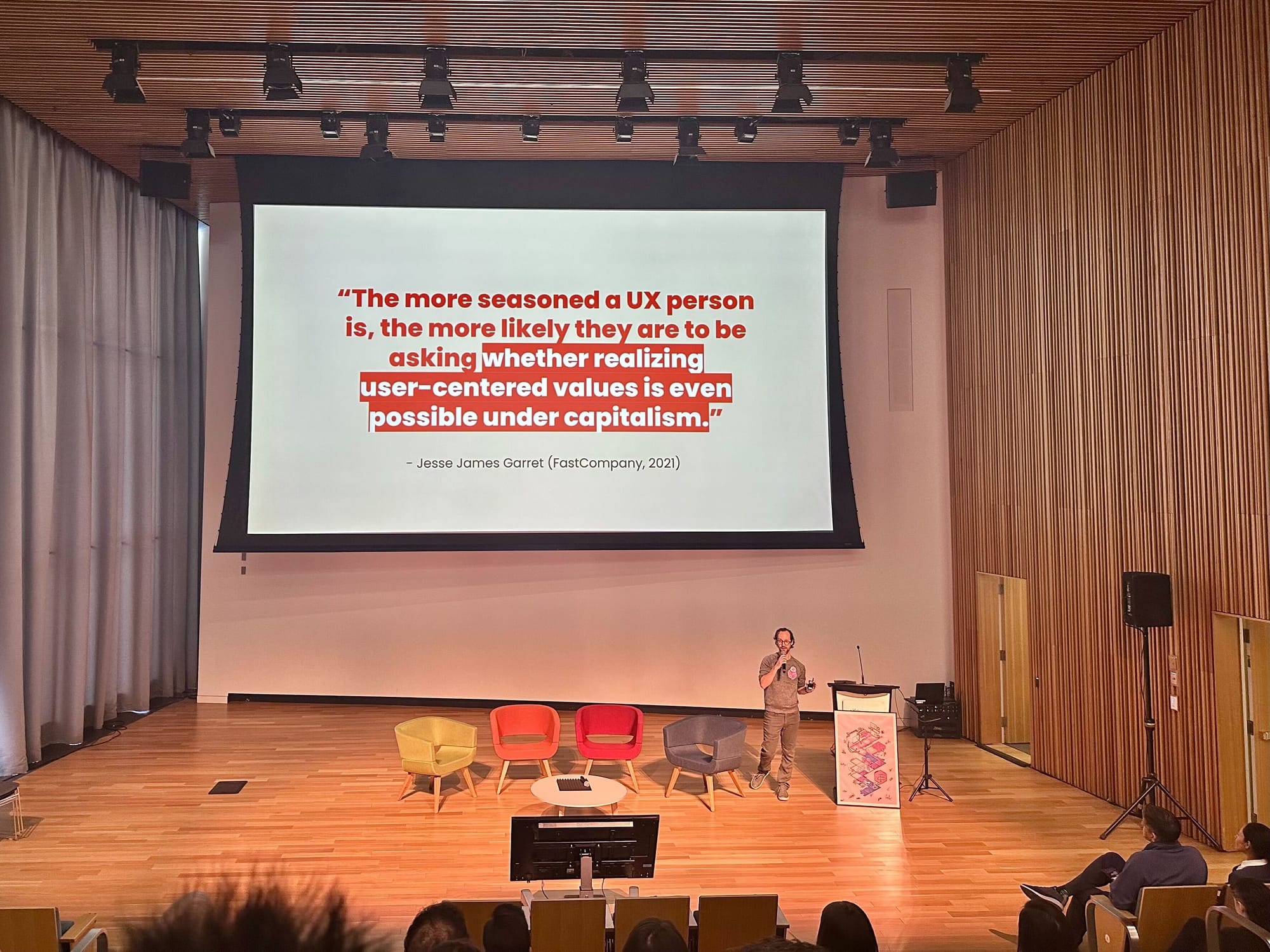
At the end of the day, it's not Product that's the source of UX's current woes, it's the four horsemen of the so-called Design Reckoning: an AI arms race, global political instability, runaway inflation, and our good friend enshittification. UX and Product people are in the same life raft, trying to create meaningful products and experiences, despite the economic storm that surrounds us.
Many have put forward ideas of how to fix this dynamic. But taken individually, many of the solutions from influencers and thought-leaders (i.e. superior craft/taste, vibe-coding) feel insufficient.
There are a few things I believe to be true:
- Relying on craft and taste alone is retreat from the strategic value of design.
- Taste is subjective; vibe coders will only become more sophisticated with time.
- Gate-keeping runs counter to the values of UX. We're a discipline of builders, dreamers, and optimists — yet we've fallen into a protectionist habit.

Instead, I believe the answers must come from UXers embracing our peers in Product. Speaking from experience, as I've gone deeper into my journey learning about Product leadership, I've begun to identify more as a hybrid — 60% Product, 40% UX.
We don't all need to become Product people (though it might be a good path for some of us). Nor do we need to occupy both roles ourselves (though having some generalist skills doesn't hurt).
What's important is that we stop fighting, that we reach out with curiosity. For me, it was getting curious about Product that helped me see new ways of looking at the world.
Act Three: UX 🤝 Product
The talk delivered three strategic moves for UXers and Product people to make in true partnership.
- Move upstream to deliver strategic value
Stop waiting for permission, because influence doesn't live in a Figma frame. We're trained to build alignment, but our real value comes from transforming experiences, and through relationships with customers. - Expand our horizons beyond design and delivery
UX and Product can learn from each other — UX brings user empathy, design process, and craft/taste; while Product brings prioritization under uncertainty, business sense, and a deliver mindset. - Design new environments
If your process doesn't make space for partnership, it's time to change the process. And, in our current age of AI-driven change, now is the perfect time to imagine something new.
I also shared one last word of advice for the perfectionists in the room. Although UXers may love our perfectly crafted mockups and carefully studied research — our real value comes from our ability to connect people across silos.
The fact is, we're at our best when we're connecting across silos, which often requires being vulnerable enough to invite others into the process. Being the subject matter expert with a narrow niche and a closed mind is a trap (and it's not a lot of fun either). But we need to be brave, and we need to be bold enough to colour outside the lines.
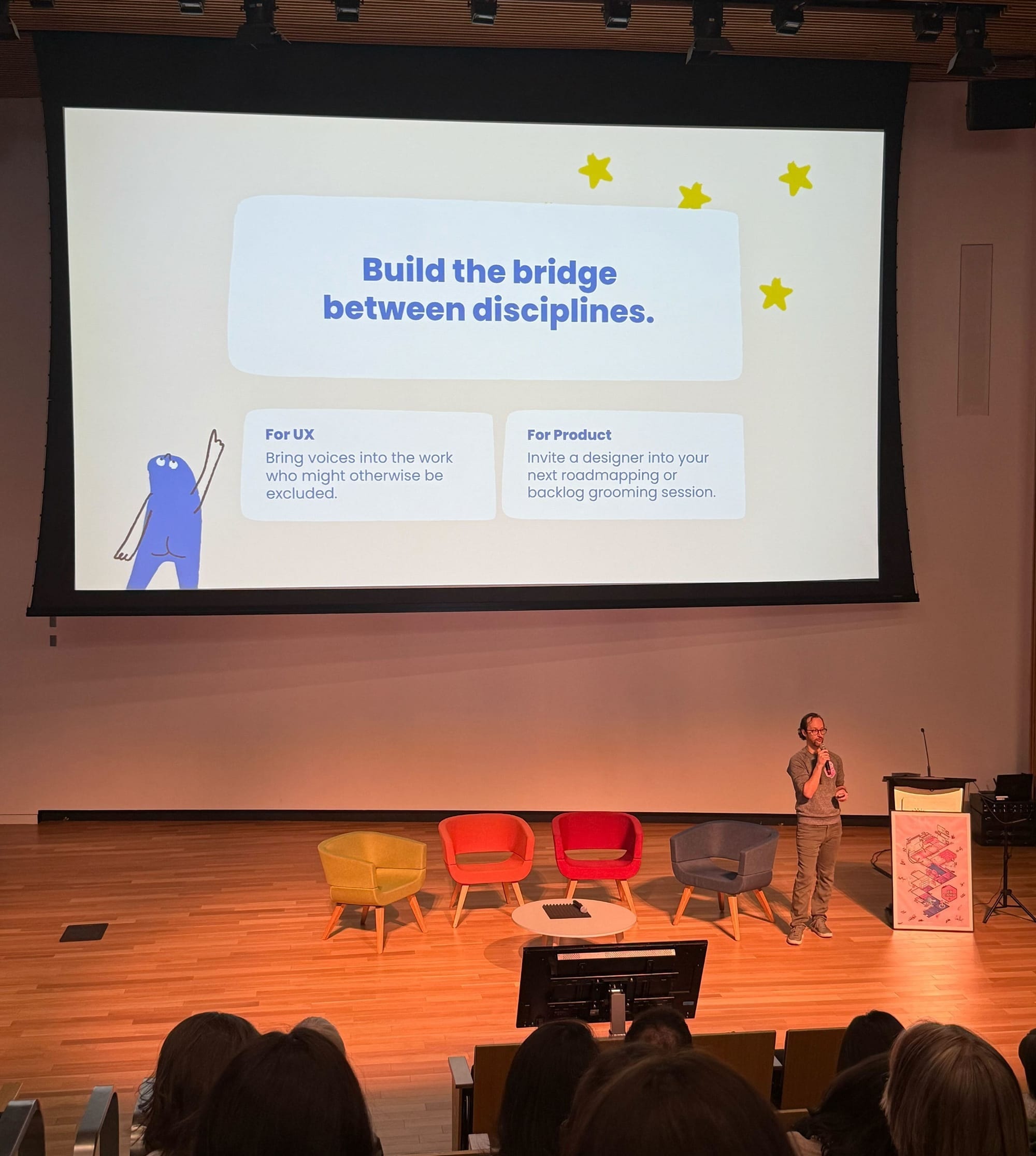
My wish is for UXers to become the boundary spanners who connect worlds, and integrate new bodies of knowledge — whether that's Product Management, or beyond. UXers can connect the dots across domains, and deliver value beyond the limitations of their job title.
If we can learn from each other and find ways to work together, we can bridge the gap between our two disciplines, we can bridge the gap between strategy and delivery. And if we can do that, the possibilities are endless. Because at the end of the day it's not just UX + Product, it's UX + Everything.
Finance. Leadership. Sales. IT. Politics. Education.
So get out there and be bold. Don't do it with territory battles, but with empathy, understanding and curiosity. It's these type of people - the individuals who are bold enough to continuously reinvent their role - who will always be in demand.
Bonus: E is for Enshittification
Evans Hunt joined UX Camp this year as a platinum sponsor. As part of our sponsorship, we decided to revisit the theme of my talk from last year, with an illustrated children's book titled: E is for Enshittification.
A is for Algorithm. B is for Billionaire. C/D is for Cory Doctorow.
Or my personal favourite, X — which of course, is for Twitter.
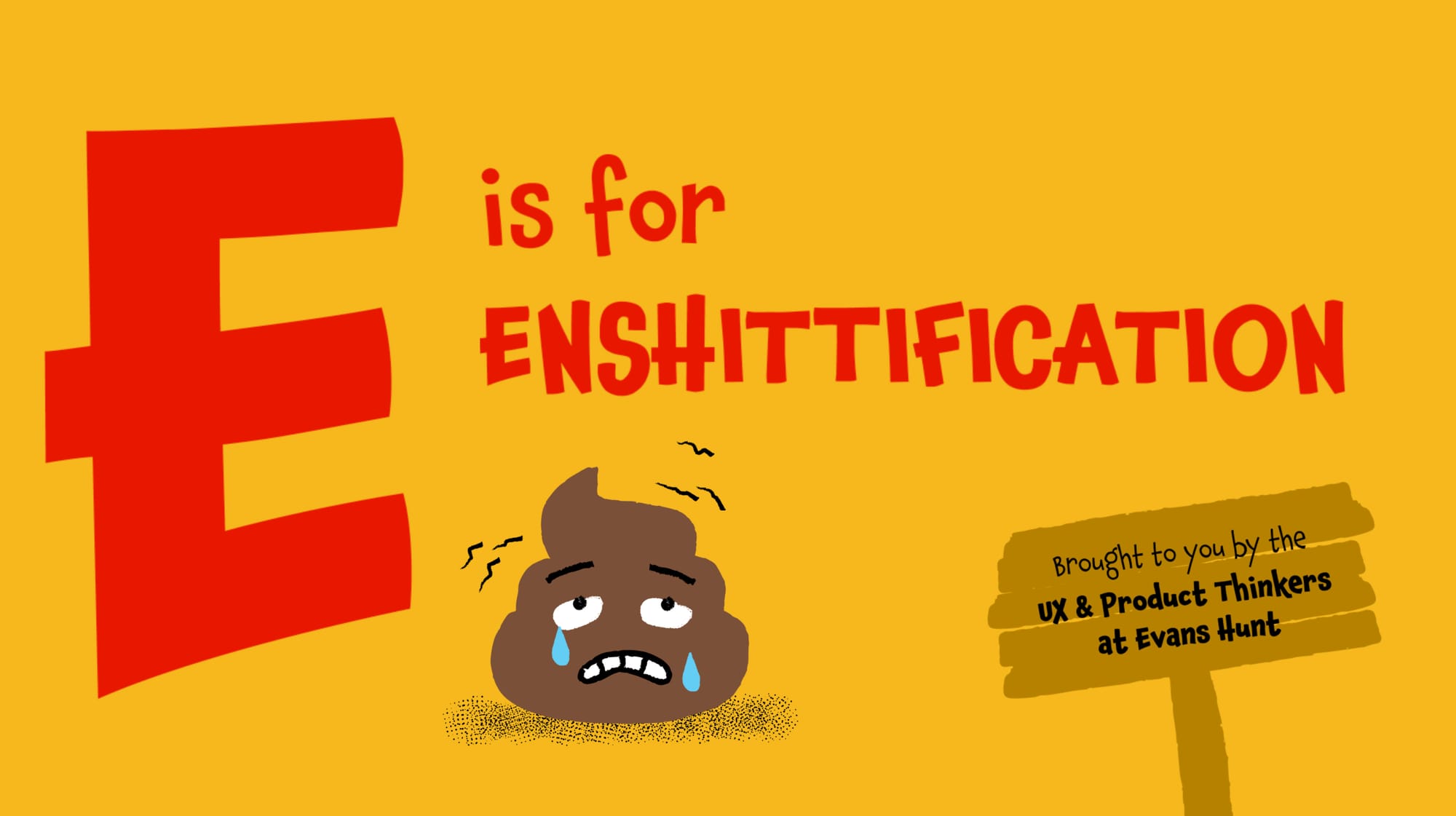
We shared 250+ copies with the community and the reception was incredibly positive.
As one person shared with me after reading the book — it takes a complex, system-level subject like enshittification, and makes it so simple and fun that even a toddler can understand it. The medium might be different, but that's exactly what good UX and Product leadership brings to the table.
And it's a good lesson for all of us, because "writing a children's book" is nowhere to be found in my own job description.
Thanks
My thanks to Calgary UX and Evans Hunt for the opportunity to share this talk.
If you found this article useful, please subscribe to receive occasional email updates on UX, Product, and Design leadership.