Writing
The Reckoning: Integrating UX Design & Product Leadership
Building the bridge between disciplines. Finding the shared purpose that unites us instead of what divides us.
The Reckoning
In part one of this series, we diagnosed the split diamond problem — when design is reduced to execution, we limit the contribution and sense-making capabilities of strategic designers. This is the so-called "design reckoning" that has dominated leadership conversations over the last year.
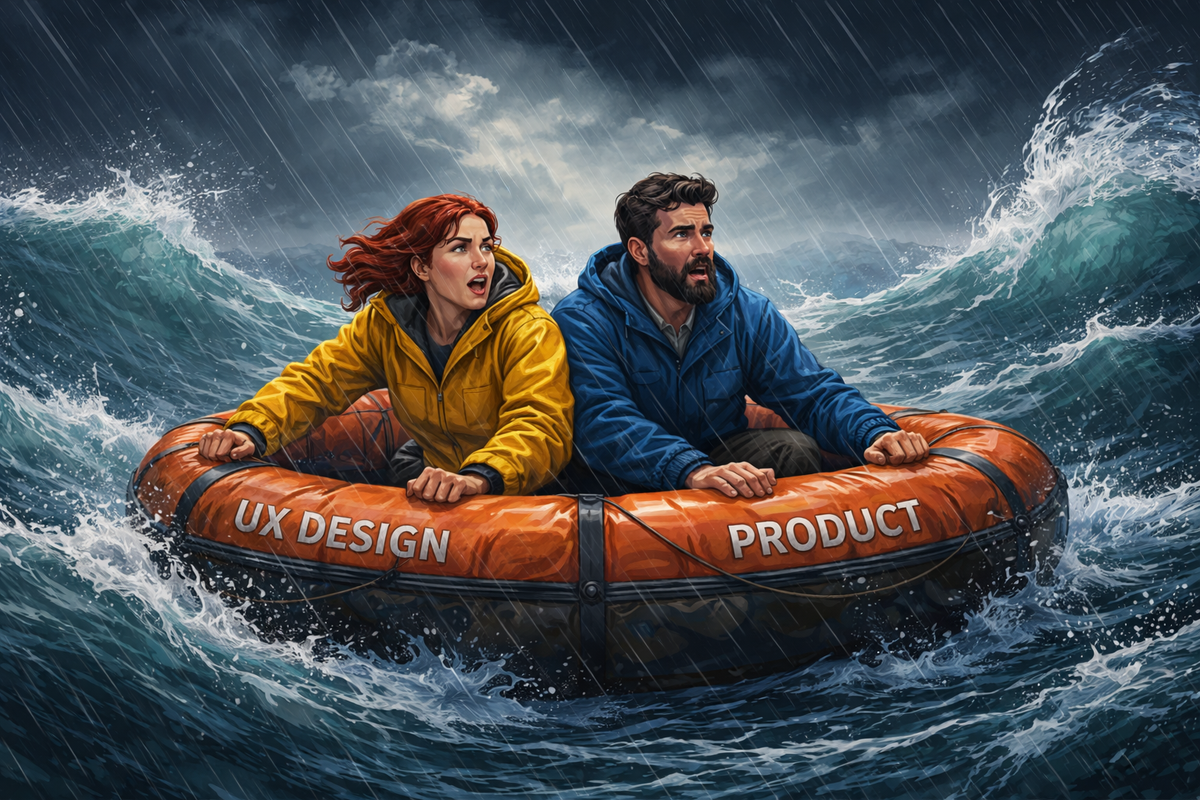
My favourite reaction to part one came from Julia Juco, who captured the sentiment perfectly by noting that in complex organizations, "it almost feels like UX and Product cling together on a dinghy in the wave of business leadership."
It's the perfect visual to keep in mind as we think about what comes next.
Let's start with a potentially radical idea. UX didn't lose. We won.
UX Didn't Lose... We Won
It's an uneasy truce — an imperfect marriage between humanist thinking and capitalist imperatives — but today, you'd be hard-pressed to find a business or technology leader who doesn't accept the necessity of deeply understanding customer needs.
Whether you call it product-market fit, jobs to be done, user experience, or even design thinking — UX practitioners succeeded in convincing the world that user-centred thinking matters.
That victory, however, came with an unintended consequence... we disrupted ourselves.
Bringing the voice of the customer was the basis for design's role in shaping direction. It was the ticket that cracked open the doors to the rooms where decisions get made. But when understanding users became part of everyone's job, design's strategic footing dissolved.
The Voice of The Customer
If you're still feeling skeptical about the notion that UX won, it's helpful to review the early history of product management.
The Product role in technology teams was initially established at engineering-centric companies like Microsoft and Google. The product manager (or program manager in some cases) was there to balance technical constraints with business goals (mainly delivery), acting as the interface between engineering teams and executive stakeholders. Users, in most cases, were nowhere to be seen.
It was in the post dot-com landscape that design began to question this technology-centric approach, with firms like Adaptive Path advocating for a new formula, one that started with understanding the user's needs. As the field emerged, designers, researchers, and consultants brought the voice of the user into rooms where customer understanding had previously been limited or absent.
And it worked. Report after report demonstrated how organizations that led with user-centred design consistently outperformed their peers.
At the same time, the runaway success of the iPhone sparked unprecedented interest in design as a source of competitive advantage. In less than a decade, entire businesses were compelled to reshape their offerings for mobile-sized screens, putting customers in the driver's seat and sending demand for design expertise through the roof.
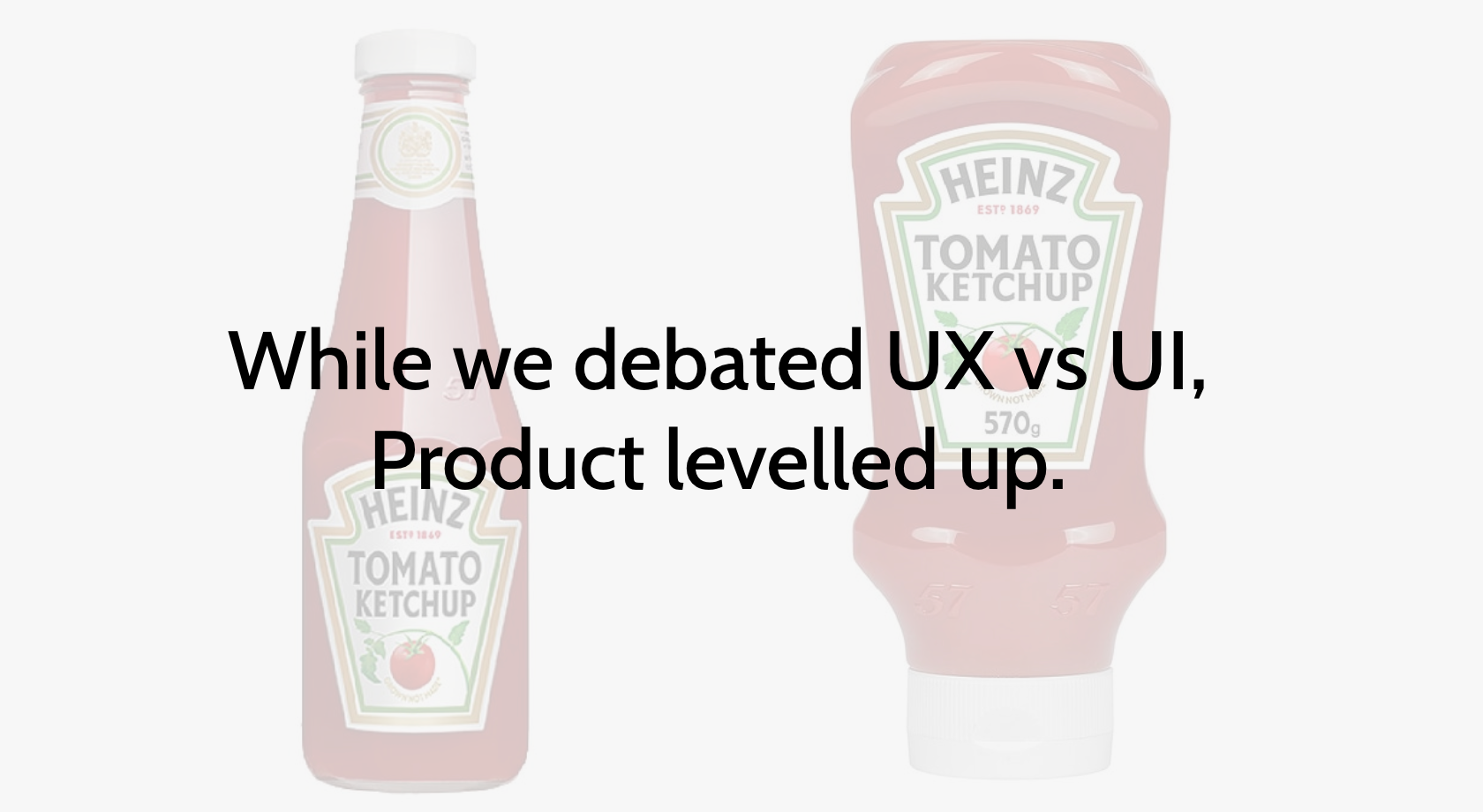
The Experience Is The Product
So product management evolved. Product leaders adopted practices borrowed from UX including user interviews, usability testing, personas, journey mapping, and feedback loops — while also operationalizing these activities for delivery in agile development workflows. Design's tools for strategic sense-making morphed into a set of processes for product discovery.
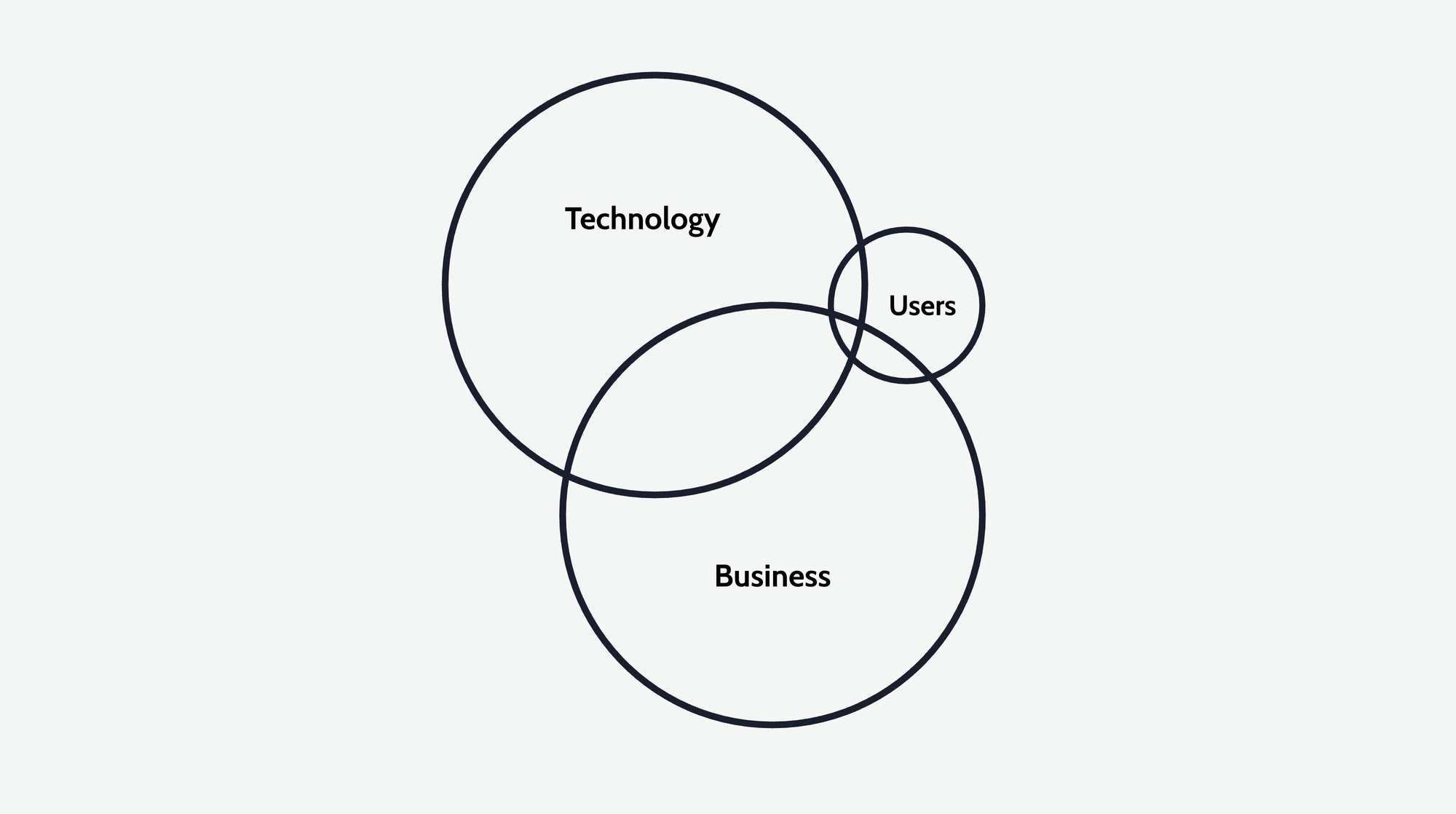
Today's product teams aim to deliver an experience that balances all three domains — business, technology, and the user. Product aims to connect customer problems to business outcomes.
In fact, the product and the user experience are so intertwined, that it can be hard to tell where one ends and the other begins.
"The daylight between Product and UX is getting smaller all the time. If you have a Venn diagram of all the things that product people do and all the things that UX people do, there's more and more overlap every day."
- Jared Spool
But with Product becoming ever more user-centred, the overlap between roles has increased. That overlap explains some of the tension — when product and design both operate in the same space, it's easy to step on each other's toes.
It's The Economy, Stupid
So if UX's thinking won, why does everything feel so bad?
For the people who came up in design during this time, part of the reason is that our thinking became part of the default operating system. The voice of the customer — once design's strategic differentiator — is now table stakes. We got sherlocked.
But that's not the whole picture. Just when designers were beginning to step into leadership roles, the business environment shifted. The economic storm that now surrounds us dialled up the pressure — not just for newly minted design leaders, but for all of us.
As designers, we think the grass is greener on the other side, but product leaders are dealing with their own reckoning. UX and Product are stuck on the same life raft, taking on water in the mother of all storms, while still fighting to build meaningful experiences for users.
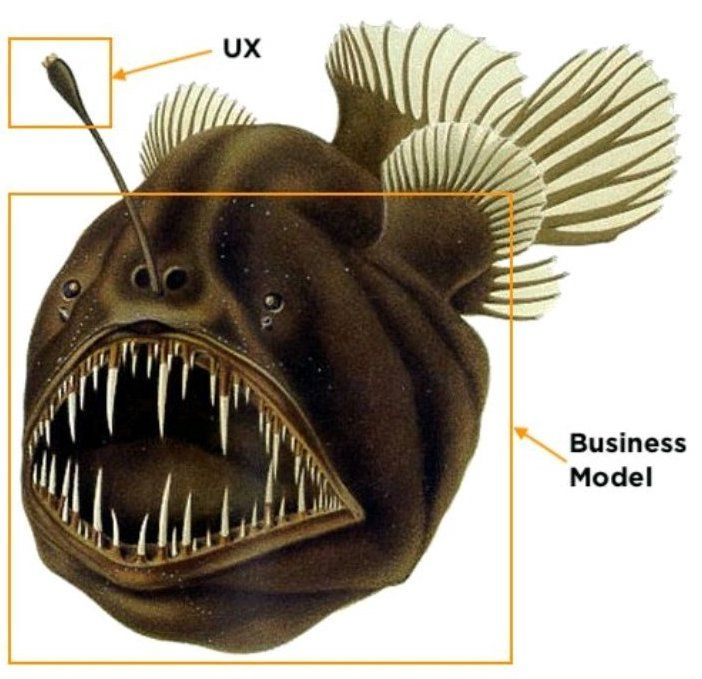
The truth is that even when everybody agrees on the value of user-centred thinking, there's a mismatch between the value-creation orientation of UX/Product teams and a business environment that suddenly reoriented around cost-cutting and efficiency in the last few years.
It's hard enough to build something new in normal circumstances, but the added challenges of layoffs, slashed budgets and AI mandates make it nearly impossible for teams to do anything that won't provide a guaranteed return.
The impact of UX/Product is limited by what the business model enables, and for many teams right now, that possibility space has collapsed inwards.
A Bridge Between Disciplines
Now, considering we're stuck on this life raft together, I want to take a brief detour to acknowledge the real differences between design and product.
These differences run deep. Product's roots are in management. The discipline values shipping and iteration — optimizing for delivery while planning for longer term road maps. Design, on the other hand, is a craft-oriented discipline. Designers value the experience above all else, optimizing for quality through carefully considered outcomes and thoughtful attention to detail.
These are important distinctions, because even when we share a common goal, UX and Product each bring a different set of values to the table. Yes, we're trying to solve the same challenge, but we're looking at it from our own vantage point.

If you've seen The Gorge on Apple TV (a somewhat campy flick featuring two snipers, each responsible for a defensive tower on either side of a giant, mysterious chasm).
In the movie, the operators are trained with a single, all-important rule – do not make contact with the other side. Of course, it's not long before they break the rule. They get to know each other, fall in love, and venture into the gorge to fight the monsters and take on the military program responsible for their creation.
This is the picture that comes to mind when I think of UX and Product. Two disciplines defending isolated towers, rarely reaching across to understand the people on the other side.
But if we want to defeat the monsters and weather the storms of our day, we need to reach across the divide. We need to build bridges so we can have a larger impact. Together.
Building True Partnership
When UX and Product people struggle to work together, it's easy to say the other person is "doing it wrong" or "being difficult to work with" — but the more mature take is that they're operating with information, incentives, or values we're not yet aware of.
Design, when given the space to operate across both problem and solution space, can be so much more than a "make it look good" service. Meanwhile, Product has the opportunity for impact that many designers crave. Working together helps us both, but there needs to be openness, respect, and trust on both sides of the divide. We need to be vulnerable enough to admit there might be something the other side knows that we don't.
But for designers to be good partners, we need to level-up in the same way that product management once did when they adopted user-centred thinking. We should be open to understanding product's perspective rather than fighting for design purity. When we apply our empathetic skills of user understanding to other disciplines, we can more effectively navigate the complex stakeholder environments we operate inside.
Similarly, product leaders can embrace their design counterparts as partners in navigating the problem space. Given their position, product tends to have more of a defined seat at the table, or at least proximity to one. Partnering with design can help product leaders make the most of their position, with a more confident, clear-eyed vision of the future.
True partnership is rare, but it's the only real path forward — for both disciplines.
The Role of Boundary Spanners
Throughout history, integrating knowledge across specialized domains has been a consistent source of innovation.
In the Mad Men advertising era of the 60's and 70's, the partnership between Art and Copy fuelled a golden age of branding. When digital marketing took the forefront in the 2000's, integrating more analytical Strategy/Planning with Creative enabled unique and memorable applications of technology.
Today, nearly all organizations have become technology companies. And just like the boundary-spanning partnerships of previous eras, the combined perspectives of UX and Product bring together the tools to navigate uncertainty, build things that matter, and create lasting outcomes.
Effective integration requires individuals who can span the boundary — people who can speak the languages of both disciplines while navigating the shared space between them. In Part Three, I'll outline practical approaches to building the bridge, with three potential paths for UX Designers to thrive in this new shared landscape.
This article is the second in a three-part exploration into the overlapping responsibilities of UX Design and Product leadership. For part one, click here. If you're interested in part three, please consider signing up for email updates.