Writing
Mini Case: AI in Travel Workshop
Leading a series of workshops that led to a successful proof-of-concept, and a pilot program for AI-generated trending travel recommendations.
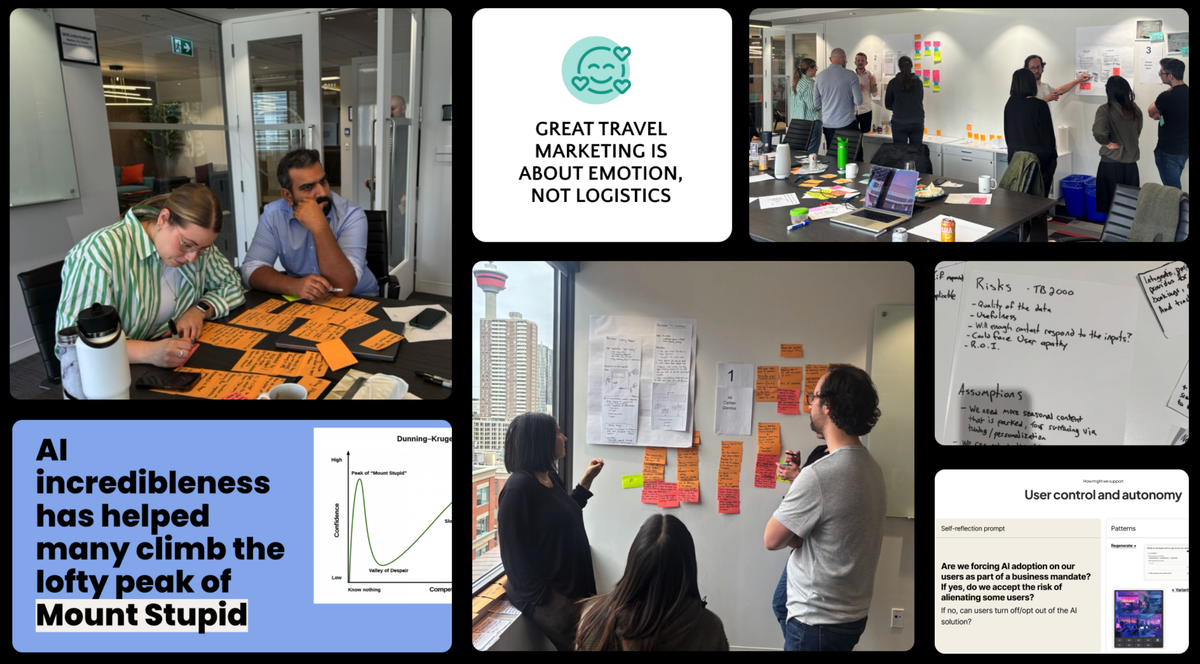
One of the initiatives I was most proud of in 2025 was an AI workshop for Travel Alberta. Part of the reason for my pride? Nobody asked for it.
I identified an opportunity after overhearing one of our VP's say "I've got a board presentation coming up, and I want to share how we're approaching AI" — a marked change in attitude from 6 months earlier.
The Opportunity
So I pulled together a proposal. My initial idea was for a cross-team hackathon (combined agency design/dev/product team + key client stakeholders), inspired by thought leadership from McKinsey that found a well-designed hackathon can reduce time-to-market by 25-50%. However we later simplified to a workshop series defined first by agency-led exploration, and followed by collaborative bets on the path forward.
Rather than looking at AI through the lens of productivity enhancements, we decided to explore how AI capabilities might be applied to some of our most pressing product challenges.
Part One: Ideation Workshop
- In person. Full day. 10-15 people.
- Start with knowledge sharing — short, 15 min lightning talks from UX/Tech/Product about the current state of AI
- Establish the challenges and user types
- Breakout into teams and flesh out ideas
I defined a high level approach, then handed the workshop reins to an UX Strategist on the team who was looking for an opportunity to flex her facilitation muscles. I'm happy to say that she absolutely crushed it — orchestrating a packed agenda filled with knowledge sharing, problem space definition, sketching, pitching, and solution refinement.
It was also noteworthy that our engineering team was able to join for the day, as these voices can sometimes be excluded from ideation.
Challenge One:
How might we use AI to help website visitors discover the most inspiring and relevant content for their needs?
Challenge Two:
How might we use AI to streamline content management for tourism operators?
The group split into four teams of 3-4 people each. Teams were responsible for generating one proposal against each challenge, for a total of 8 concept ideas.
Some team members made fun of it, but I instituted a "no chatbot" rule for the ideation session. I wanted people to push beyond chatbots and explore new ideas with technology as an enabler of new capabilities, not just a surface-level interaction layer.
Part Two: Prioritization Workshop
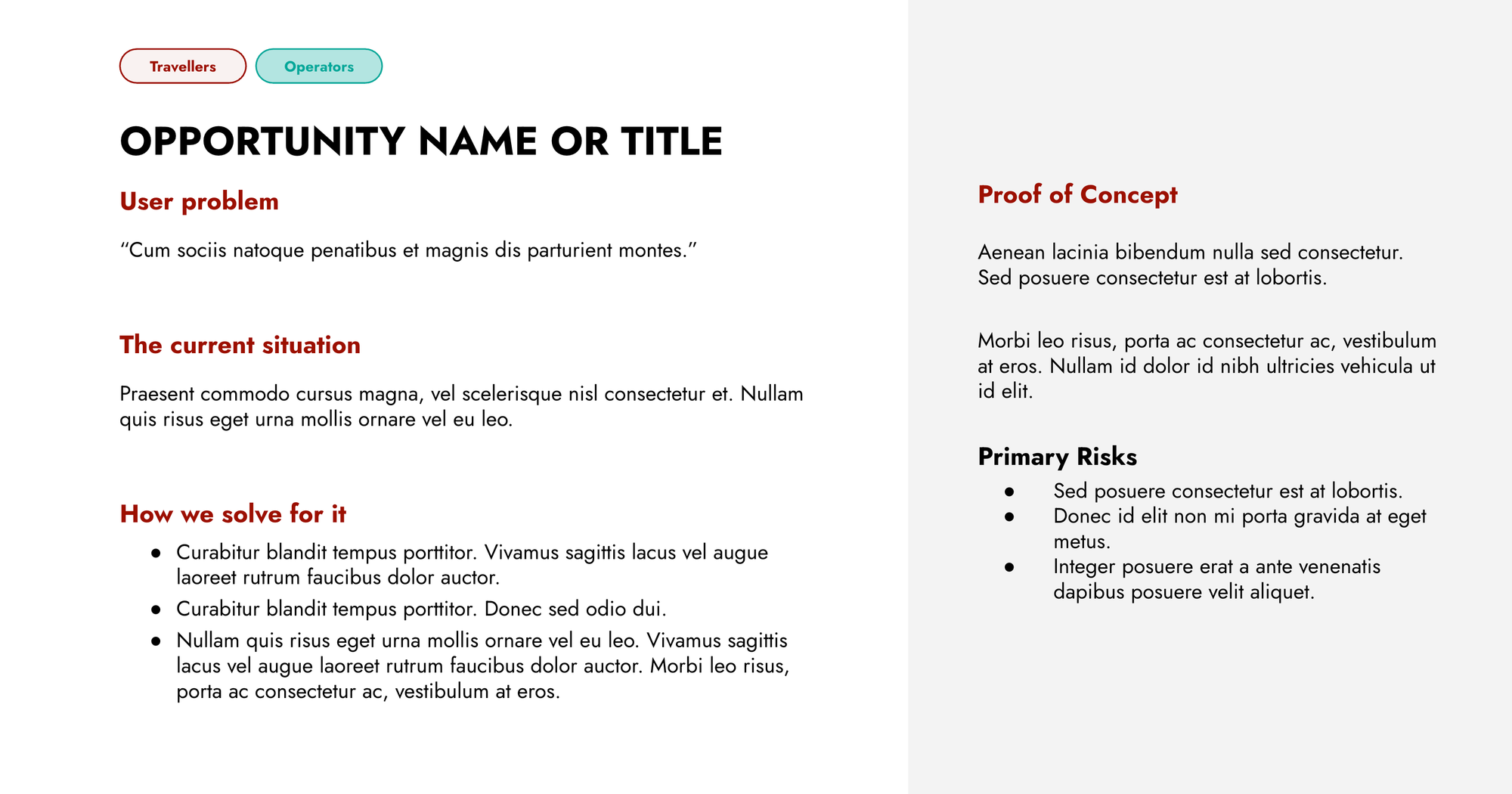
With the team workshop completed, I took a day to synthesize the results, then invited clients to our office for an afternoon. I put the sketches on the walls, along with a single-page summary of each idea.
- Audience
- The Problem
- The Current State
- How It Would Work
- Proof of Concept Proposal
- Primary Risks
Stakeholders rotated through each station providing reaction and commentary. Finally, we used dot-voting to select opportunities to move forward with.
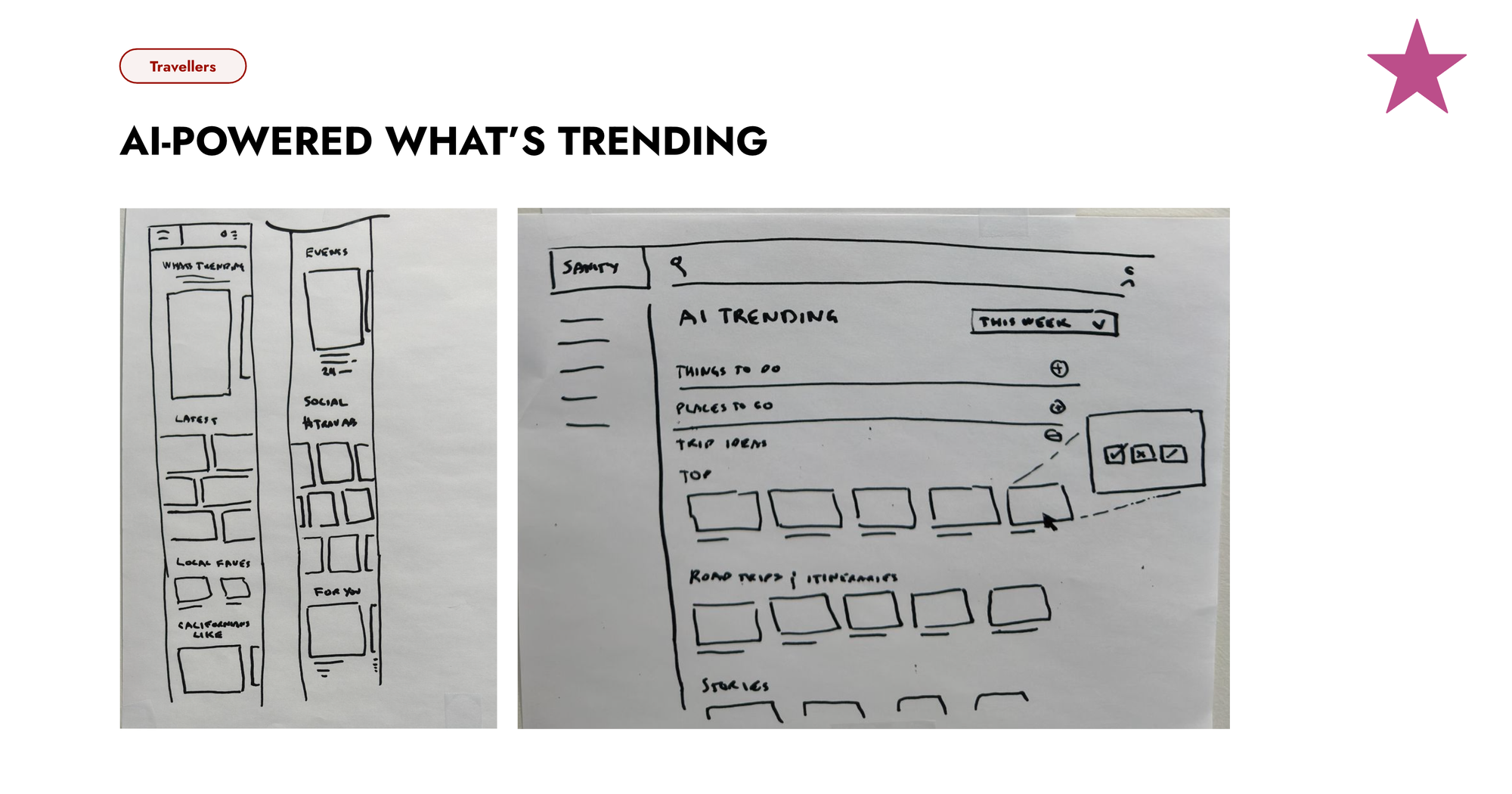
The team prioritized the development of two proof of concepts — one for travellers, and one for tourism operators. I advocated for proof of concept development first so that we could test the system, assess whether things were working, and build confidence before releasing the functionality to the world.
In travel, a destination's primary currency is trust — trust that can be lost in an instant with an AI hallucination or false statement. Starting small and holding back on the big bang launch was a way to embrace new spaces, while limiting the downside risk.
Reflection & Results
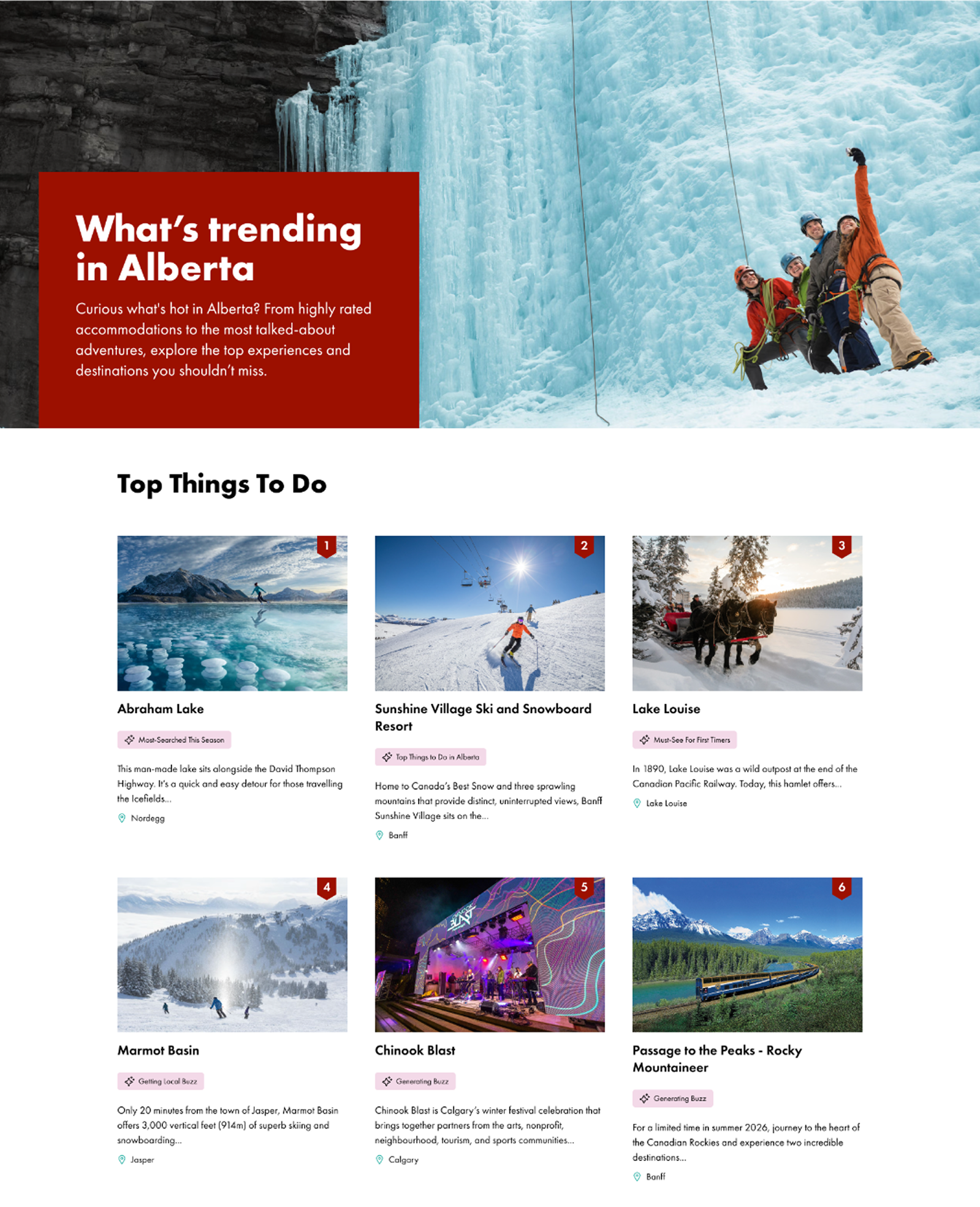
Over the next 6-8 months, the team explored, prototyped, and refined the two concepts. One has since launched: an AI-powered page surfacing trending travel experiences in Alberta.
The experience builds on previous traveller interest in learning What's Trending. It uses AI analysis of website analytics, social sentiment, and more to generate a list of trending experiences from Travel Alberta's internal database of tourism operators called ATIS.
AI recommendations are then vetted by content authors using a custom Sanity CMS implementation. There's still plenty of room for improvement but the functionality has already turned a painful twice-a-year content task into a monthly activity — a 6x improvement in content velocity — that demonstrates the power of custom-developed human + AI tooling.
One of the other positive outcomes from the workshop was a change in team sentiment. The UX strategist facilitating the workshop cleverly implemented a survey to measure the team's before/after state.
Before the workshop, sentiment on working with AI was 3.2/5. People were skeptical, and not convinced the day would be a valuable use of their time. After the workshop, sentiment jumped to 4.6/5.
“[We] achieved a great result, from an event I was kind of dreading.”
“Kind of astonished at how productive and positive it was.”
She met the team where they were, then pulled them into new and uncharted territory — that's the mark of a great facilitator.
Hat tip to Ellie Forte, the facilitator mentioned in this mini case study. Also thanks to the Travel Alberta Product Squad, and the Evans Hunt team.
If you found this article useful, you can subscribe to receive occasional email updates on UX, Product, and Design leadership.